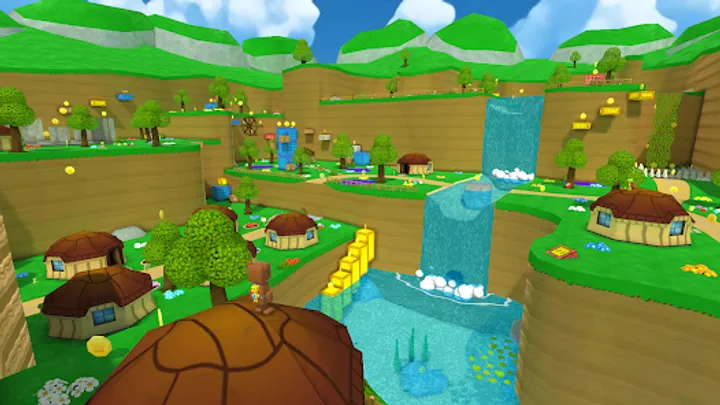


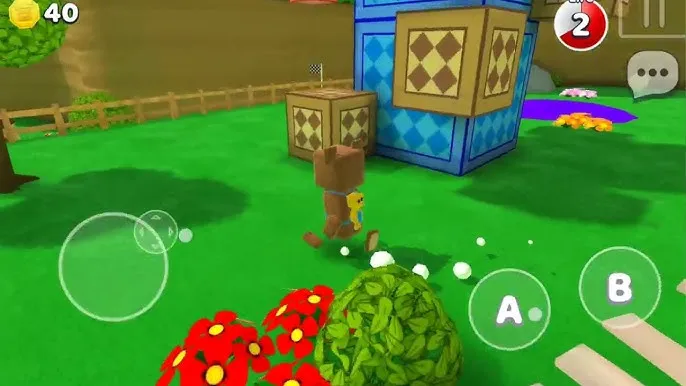
In the early stages of development, Super Bear Adventure sought to replicate the weight and momentum found in classics like Super Mario 64. Baaren, the protagonist, possesses a distinct sense of inertia; he does not stop instantly, and his jumps carry a specific arc dictated by his running speed. This physics-driven approach is what gives the game its "soul," making simple traversal feel more engaging than a standard mobile runner. However, this momentum-based movement creates the game's primary issue when paired with the precise platforming required in later levels.
The specific problem arises when the player must land on small, rotating, or moving platforms. Because Baaren’s feet have a "low-friction" property, he often slides off the edges of platforms that he seemingly landed on perfectly. This isn't just a matter of skill; it's a conflict between the visual representation of the bear and the invisible physics capsule that defines his presence in the game world. In the Capital City and beyond, this "slippery" nature turns environmental navigation into a battle against the engine's own momentum logic.
The Hitbox Crisis in Shneaky Peak
As the player progresses to the mountain regions, the stakes of platforming increase. Shneaky Peak introduces verticality that punishes even the slightest misstep. Here, the hitbox issue becomes a central frustration. While Baaren’s character model suggests a rounded, soft entity, the game treats him as a rigid cylinder. This means that a player might fall because the corner of this invisible cylinder stepped over an edge, even though the bear's feet are visually still on solid ground.
This technical gap is exacerbated by the game's camera system. Because the camera often struggles with tight corners and steep inclines, players frequently lose the perspective necessary to judge where their hitbox actually ends. This leads to a trial-and-error gameplay loop where the player isn't learning the layout of the level, but rather learning to compensate for the "invisible boundaries" that the graphics fail to communicate accurately.
Environmental Hazards Breakdown
- Ice Surfaces: Multiply the existing friction issues, making fine-tuning a nightmare.
- Moving Platforms: Often "desync" from the player’s character model if the frame rate dips.
- Lava and Water: Instant-fail or damage zones that have larger hitboxes than their visual textures suggest.
Combat Mechanics and the Reach of the Purple Honey
Combat in Super Bear Adventure is ostensibly simple: a jump-and-stomp or a spin attack. However, the purple honey corruption introduces enemies with erratic movement patterns that highlight the limitations of Baaren’s offensive hitboxes. The spin attack, while visually covering a 360° radius around the bear, often fails to register hits on enemies that are vertically slightly above or below the center of the character model.
This vertical hitbox limitation creates a "safe zone" for enemies that shouldn't exist. In the Desert and Forest kingdoms, flying enemies exploit this mechanical blind spot. A player might perform a perfect spin attack, but because the enemy was two pixels too high, the attack misses, and Baaren takes damage instead. This creates a defensive playstyle where players are forced to wait for enemies to reach a specific "hitbox sweet spot" rather than engaging in dynamic, aggressive combat.
The Boss Encounter Paradox: Giants with Tiny Weak Points
Bosses in Super Bear Adventure are designed to be spectacles—large, imposing creatures that dominate the arena. Yet, the "Specific Issue" remains the same: the interaction between a high-momentum player and a static-hitbox boss. During the fight with the Giant Golem, for example, the player must strike specific orbs. The challenge is not the boss’s attacks, but rather the fact that Baaren’s momentum often carries him through the weak point and directly into the boss’s damage-dealing body.
The mechanical frustration here is that the game does not provide a "knockback" or "bounce" effect upon hitting a boss unless it is a fatal blow. Instead, Baaren often clips into the boss's model. Once inside the boss's hitbox, the player takes rapid, repeated damage. This turns boss fights into a "hit-and-run" exercise where the most dangerous part of the fight isn't the boss's programmed moves, but the risk of getting stuck inside the enemy's geometry due to physics-based sliding.
The Evolution of the Long Jump: Skill Ceiling or Bug?
Advanced players have discovered that certain combinations of movement—crouching while running and jumping—allow for a "long jump" that bypasses large sections of levels. While this has been embraced by the speedrunning community, it highlights a lack of "capping" on physics momentum. The game engine allows Baaren to stack velocity in ways the developers likely didn't intend for the average user.
This creates a divide in the community. One group sees these physics glitches as a feature that adds depth, while another sees them as an issue that breaks the intended narrative progression. If a player can jump over the gates of a kingdom before collecting the necessary tokens, the "Adventure" aspect of the game is compromised. The issue is a fundamental lack of "velocity clamping," which allows the physics engine to override the game’s structural rules.
Kingdom of the Desert: Friction and Sand Physics
The Desert kingdom introduces sand dunes that behave differently than the grass of the Forest. Here, the developers attempted to simulate sand by further reducing friction and adding a "sinking" mechanic. While atmospheric, this emphasizes the "Slippery Bear" problem. Navigating the Sphinx or the hidden temples requires precise jumps onto narrow pillars, which is fundamentally at odds with the "sliding" sand physics.
Players often find themselves "jittering" on slopes. This jitter occurs when the physics engine cannot decide if Baaren is sliding or standing still. This mechanical instability makes the Desert one of the most difficult regions not because of enemy density, but because the floor itself is an unreliable actor in the game's logic. It turns a platformer into a game of "physics management."
Navigation Challenges in the Desert:
- Quick-Sand: Requires constant jumping to reset the sink-depth, which consumes stamina.
- Steep Dunes: Can trigger an unintended sliding animation that resets the player’s progress.
- Hidden Pillars: Often have "slippery" tops that do not support Baaren's momentum-heavy landing.
The Token Economy and the Pressure to Optimize
As the game progresses, the player is required to collect tokens to unlock new areas. This introduces a meta-layer to the movement issues. To collect tokens efficiently, players try to move as fast as possible, which triggers the high-velocity physics glitches mentioned earlier. The game effectively rewards players for pushing the physics engine to its breaking point.
This creates an "Optimization Pressure" where the player feels they are playing the game "wrong" if they take the intended, slower paths. Because the tokens are often placed in precarious positions, the player is forced to engage with the worst aspects of the hitbox system—standing on the very edge of a platform—to reach them. The reward system and the physics system are essentially pulling the player in opposite directions.
The Snow Valley: Verticality and Falling Through the World
The Snow Valley is the pinnacle of the game’s environmental design, but it is also where the "Collision Detection" issue is most prevalent. Because of the complex geometry of the caves and cliffs, there are numerous "seams" in the world. A high-momentum jump into a corner can occasionally force Baaren through the floor, sending him into the "void" beneath the level.
This clipping issue is a direct result of the physics engine calculating movement faster than the collision detection can verify the floor's presence. In a game about exploration, falling through the floor is the ultimate immersion breaker. It transforms the world from a solid kingdom into a fragile shell, making the player wary of exploring the very corners where secrets are usually hidden.
The Final Confrontation: Narrative Stakes vs. Mechanical Flaws
By the time Baaren reaches the final boss, the player has usually mastered the art of "compensating" for the physics. However, the final fight requires a level of precision that the game hasn't demanded until now. The specific issue of hitbox desync becomes a life-or-death struggle. The boss’s attacks have visual cues that don't always match their damage zones, requiring the player to dodge "early" or "late" based on their knowledge of the engine rather than their reflexes.
The climax of the story is meant to be an emotional resolution to the purple honey saga. Yet, for many, it becomes a final exam in "Game Engine Quirks." If the player dies because a hitbox touched them while they were visually clear, the narrative impact of the finale is diminished. The "Specific Issue" isn't just technical; it's emotional, as it prevents the player from fully immersing themselves in the triumph of the bear.
Conclusion: The Charm of the Imperfect Platformer
Ultimately, the issues within Super Bear Adventure—the slippery physics, the rigid hitboxes, and the velocity glitches—are what define its character. While these are technically "flaws," they are the hallmarks of an ambitious indie project attempting to recreate a complex genre on a limited platform. The disconnect between the physics and the visuals creates a high skill ceiling that has fostered a dedicated community of players who take pride in mastering Baaren’s eccentricities.
Super Bear Adventure remains a beloved title not because it is perfect, but because its imperfections make the world feel alive and unpredictable. By understanding the friction between its momentum-based movement and its static collision logic, players can find a deeper appreciation for the craft involved in building a 3D kingdom. Baaren’s journey is a reminder that even in a world of rigid hitboxes and slippery slopes, the spirit of adventure remains unstoppable.